Wood Framing Contractors in Los Angeles: Your Complete Guide to Framing Done Right
Framing is the skeleton of every building. It’s what gives a structure its shape, supports the floors and roof, and in Los Angeles especially it’s what determines whether a building can withstand a significant earthquake.
When the framing is right, every trade that follows has a solid foundation to work from. The electrician can run clean lines. The plumber has square walls to work in. The drywall crew doesn’t have to fight warped studs. And when an LADBS framing inspection comes around, it passes.
When the framing is wrong, all of that breaks down. Walls that aren’t plumb. Floors that don’t land on the layout. Headers that aren’t sized correctly. These aren’t minor issues they follow a building for its entire life.
At JSN Construction, we’re wood framing contractors serving Los Angeles and surrounding areas. We handle new construction framing, roof framing, commercial framing, and additions across the city. In this guide, we’ll walk you through everything you need to know: framing types, materials, what Los Angeles’s seismic code requires, real 2025 costs, and how to find the right framing contractors near me.
What Is Wood Framing in Construction?
Wood framing is the construction method where a building’s structural skeleton is built from dimensional or engineered lumber cut and assembled into a system of walls, floors, and roof structures that carry all loads down to the foundation.
The vast majority of homes in Los Angeles and most wood-frame commercial buildings in California use one of two primary framing methods.
Platform Framing
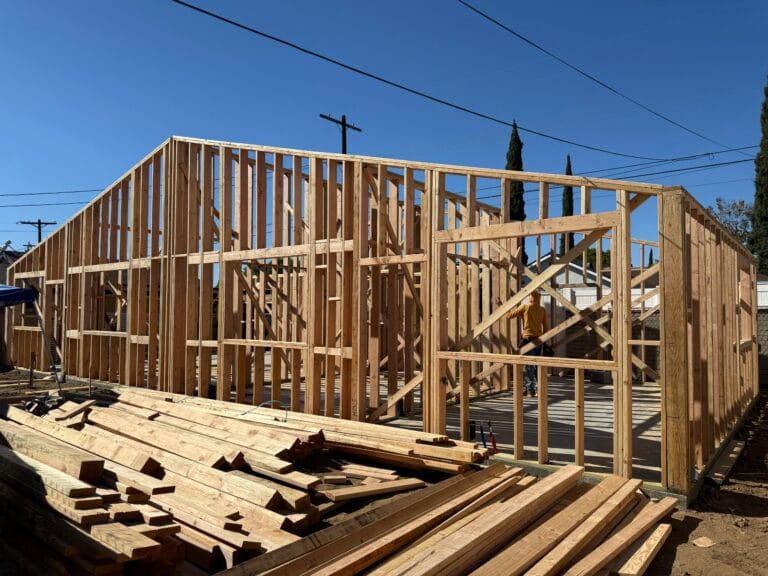
Platform framing (also called stick framing) is the dominant method used in Los Angeles residential construction. Each floor is framed as its own platform, and the walls of the next floor are built on top of it. This method is faster, easier to build with standard lumber, and more common in modern construction throughout the city.
In platform framing: studs run from the bottom plate to the top plate within each floor level. The next floor’s platform sits on top of the wall assembly below. This creates discrete platforms at each level, making construction sequential and manageable.
Balloon Framing
Balloon framing uses continuous studs that run from the foundation sill all the way to the top of the second floor without interruption. This method was common in homes built before the 1940s and is still found in many older Los Angeles neighborhoods, including Hancock Park, Los Feliz, and parts of Pasadena. It’s rarely used in new construction today.
If you’re renovating an older home in LA and your contractor opens a wall, knowing whether you have balloon framing matters. Balloon-framed walls have a continuous void that can spread fire rapidly, which is why the modern California building code requires fire blocking in these walls during renovation work.
Types of Framing Work We Do in Los Angeles
JSN Construction handles every type of wood framing project across residential, commercial, and mixed-use construction in Los Angeles.
New Construction Framing
New construction framing is the full framing scope for a ground-up building from the first wall on the foundation to the last rafter at the roof. This is the most comprehensive framing scope and requires the most coordination with the structural engineer’s drawings, the LADBS framing inspection sequence, and the trades that follow.
For new construction framing in Los Angeles, our scope typically includes:
- Floor system framing: floor joists, beams, and decking
- Exterior and interior wall framing: studs, plates, headers, and shear wall sheathing
- Second-story and third-story framing on multi-level projects
- Stair framing
- Roof framing: rafters, ridge beams, collar ties, and roof decking
- Blocking, fire blocking, and backing for fixtures and finishes
- Installation of hold-down hardware, hurricane ties, and seismic connectors
Roof Framing Contractors
Roof framing is one of the most technically demanding parts of the framing scope. The roof structure must carry the weight of the roofing material and any equipment on top, resist wind uplift, and distribute all of those loads back to the bearing walls below.
Types of roof systems we frame in Los Angeles:
- Gable roofs: Two sloping planes meeting at a central ridge. Simple to frame, common on Craftsman and ranch-style homes throughout the San Fernando Valley and Pasadena.
- Hip roofs: Four sloping planes meeting at a central peak. More complex to frame, common on Spanish Colonial and Mediterranean-style homes throughout LA.
- Flat and low-slope roofs: Minimal pitch or no pitch, common on modern and contemporary homes in Silver Lake, Echo Park, and other design-forward neighborhoods.
- Complex multi-plane roofs: Combinations of gable, hip, and valley sections on larger homes. Common in high-end construction in Brentwood, Beverly Hills, and Studio City.
Roof framing also involves installing the ridge beam or ridge board, ceiling joists or rafter ties, collar ties, and all the connections that make the assembly perform as a unit under seismic loads.
Commercial Wood Framing Contractors
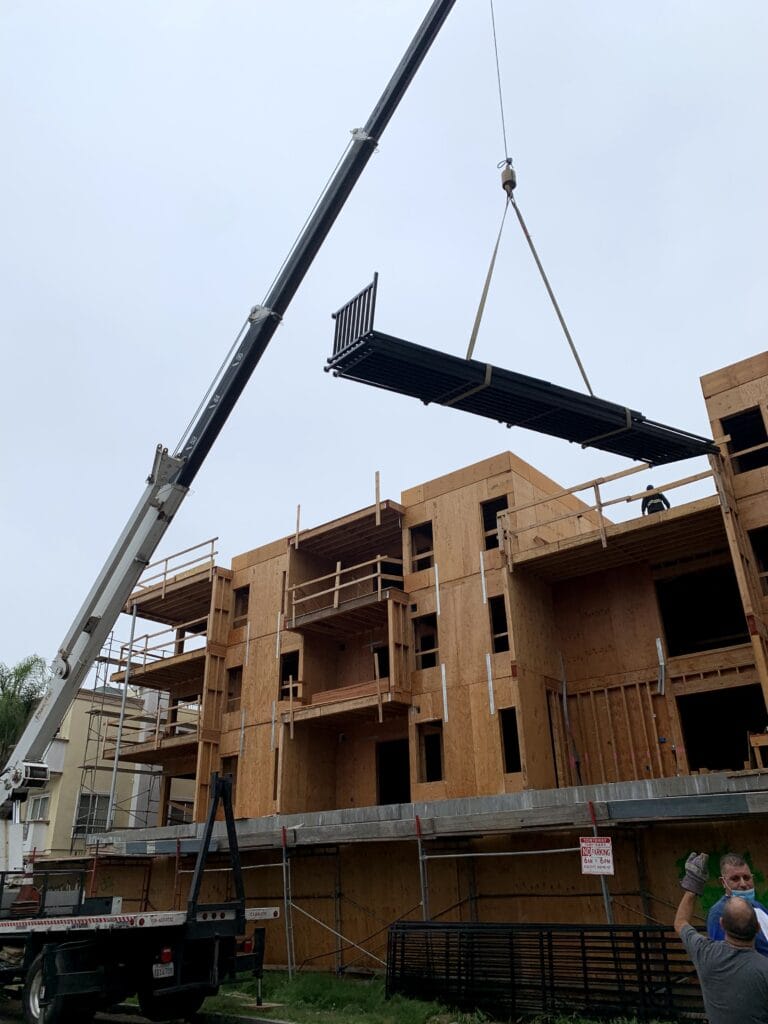
Commercial wood framing contractors work on a broader range of projects than residential framers. Multi-story apartment buildings, retail centers, mixed-use developments, and office buildings in Los Angeles frequently use wood framing up to five stories under current California code.
Commercial wood framing differs from residential work in several ways:
- Tighter tolerances and more demanding quality control from general contractors
- Larger crews and more complex logistics on multi-story projects
- More engineered lumber components: LVL beams, I-joists, and parallam beams are standard in commercial wood frame construction
- More extensive shear wall sheathing requirements for multi-story seismic performance
- Turn-key framing packages that include both materials and labor up to $3 million in project value
For commercial wood framing projects in Los Angeles, JSN Construction provides complete turn-key framing services. We staff up quickly when timelines are tight doubling or tripling crew size when a project needs it.
Room Additions and ADU Framing
Room additions and ADUs (accessory dwelling units) are one of the most active construction categories in Los Angeles right now, driven by California’s ADU laws. Framing an addition requires connecting new wood frame construction to an existing structure, which involves matching the existing framing system, providing proper bearing for new loads, and meeting current seismic framing requirements that may not have applied when the original structure was built.
We’ve framed additions throughout Los Angeles garage conversions in Burbank, second-story additions in Sherman Oaks, detached ADUs in Glendale, and rear additions on bungalows in Eagle Rock. Getting the connection detail between old and new right is critical, and it’s one of the most common failure points when less experienced contractors take on additional work.
Wood Framing Materials: What We Use and Why It Matters
Not all lumber is the same. The materials used in your framing affect structural performance, longevity, and how the building behaves over time.
Dimensional Lumber
Standard dimensional lumber (2×4, 2×6, 2×8, 2×10, 2×12) is the backbone of residential wood framing. In Los Angeles, exterior walls are typically framed with 2×6 studs at 16 inches on center to provide an adequate insulation cavity for California’s Title 24 energy requirements. Interior non-bearing walls often use 2×4 framing.
Stud spacing matters. Standard residential framing uses studs at 16 inches on center. Bearing walls and shear walls in California have specific spacing and nailing requirements defined in the California Building Code that affect seismic performance.
Engineered Lumber Products
Engineered lumber is manufactured from wood fibers, veneers, or strands bonded under pressure to create products that are stronger, straighter, and more dimensionally stable than standard dimensional lumber.
Common engineered lumber products in LA construction:
- LVL (laminated veneer lumber): Used for header beams above door and window openings, ridgebeams, and large span beams. Stronger and straighter than solid dimensional lumber.
- PSL (parallel strand lumber): Used for long-span beams and columns where high strength is needed.
- I-joists: Used for floor and roof framing where long spans are required. Much lighter than solid dimensional lumber for the same structural capacity.
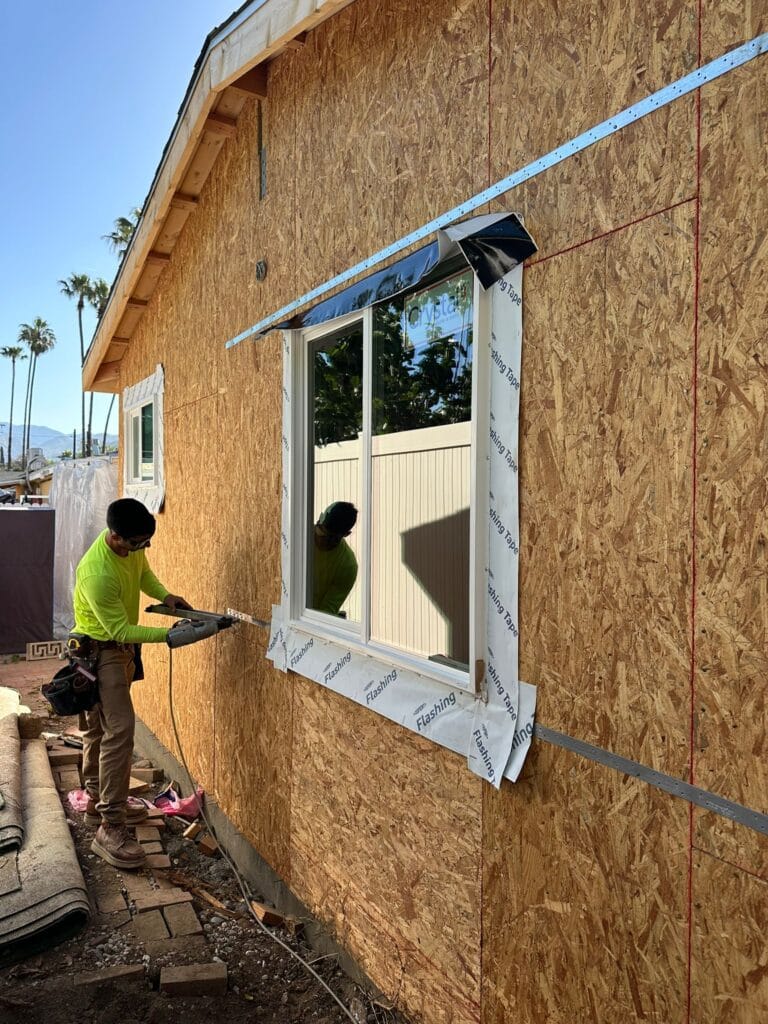
- OSB (oriented strand board): Used as wall and roof sheathing. The standard sheathing product for most LA construction. Also functions as the structural shear panel when properly nailed per the engineer’s specifications.
Shear Wall Sheathing: Why It’s Not Just Decking
In Los Angeles an active seismic zone, shear wall sheathing is one of the most critical parts of the framing system. A shear wall is a wall designed to resist lateral forces from earthquakes and wind. It’s not just framing with wood on it; it’s a precisely engineered assembly where the sheathing thickness, fastener size, and nailing pattern are all specified by the structural engineer and inspected by LADBS before drywall covers it.
Every structural framing contractor working in Los Angeles must understand shear wall requirements. Getting the nailing pattern wrong on a shear wall panel is not a minor error it compromises the building’s seismic resistance. JSN Construction frames shear walls per the engineer’s drawings every time, and we welcome the LADBS framing inspection because our work is ready for it.
Framing in Los Angeles: What the Building Code Requires
Wood framing contractors working in Los Angeles must comply with the California Building Code (CBC) and the California Residential Code (CRC), both of which include extensive seismic framing requirements that go well beyond what other states mandate.
Seismic Framing Requirements
Los Angeles is in a high seismic design category. This means:
- Hold-down hardware must be installed at shear wall ends to resist uplift forces in an earthquake. Products like Simpson Strong-Tie hold-downs are specified by the structural engineer and verified at the LADBS framing inspection.
- Hurricane ties and rafter ties connect the roof framing to the wall framing, preventing roof uplift during both seismic and high-wind events (Santa Ana winds in LA regularly exceed 60 mph).
- Shear wall nailing patterns are prescribed by the engineer and must be in place before drywall covers the sheathing.
- Seismic anchors at the foundation connect the bottom plate of the first-floor wall to the foundation through anchor bolts at spacing specified in the plans.
JSN Construction installs all of this hardware as a standard part of every framing scope. It’s not a premium add-on, it’s California code, and it’s how buildings in LA stay standing.
LADBS Framing Inspection
Every permitted construction project in Los Angeles requires an LADBS framing inspection before drywall is installed. The inspector verifies:
- Stud spacing and size match the approved plans
- Header sizes at door and window openings are correct
- Shear wall sheathing and nailing pattern are per the engineer’s specifications
- Hold-down hardware, hurricane ties, and anchor bolts are installed correctly
- Blocking and fire blocking are in place per code
- Any structural members specified on the plans are present and correctly placed
Our framing is ready for inspection when we call for it. We don’t cover work before inspection passes. And we don’t skip the framing prep that makes inspections fail.
Framing Cost in Los Angeles (2025 Numbers)
Here’s what wood framing contractors charge in Los Angeles in 2025.
Residential framing (labor and materials, new construction):
- Standard framing: $7 to $16 per square foot
- Complex designs (multiple stories, varied roof planes): $12 to $22 per square foot
- For a 2,000 sq ft home: typically $14,000 to $32,000 for labor alone; $20,000 to $44,000 all-in with materials
Commercial wood framing cost per square foot:
- Light commercial (one to two stories): $18 to $30 per square foot
- Mid-rise commercial wood frame (three to five stories): $28 to $45 per square foot
By specific scope:
- Room addition framing (per square foot of new space): $10 to $20
- Roof framing only (per square foot of roof area): $5 to $10
- ADU framing (detached, 500 sq ft): $8,000 to $20,000
What drives costs higher in Los Angeles:
- Multi-story complexity: Each additional story adds coordination, material handling, and safety requirements
- Complex roof geometry: Hip roofs, valleys, and custom rafter layouts cost significantly more than simple gable roofs
- Engineered lumber requirements: Structural engineer specifications for LVL and PSL beams add material cost
- Labor rates: Framing labor in LA averages $30 to $70 per hour, depending on experience, above national averages
- Lumber price volatility: Material costs fluctuate; we provide current pricing at bid time rather than quoting from outdated averages
Why Los Angeles Homeowners and Developers Choose JSN Construction for Framing
When property owners, developers, and general contractors in Los Angeles need framing contractors near me who deliver quality work on schedule, they call JSN Construction.
We’re a licensed Class B general contractor. Our CSLB license is current and verifiable. Every crew member working on your project is covered under our license and insurance.
We frame to California’s seismic standards, not the minimum. Every shear wall, hold-down, hurricane tie, and seismic connection is installed per the engineer’s drawings and is ready for LADBS inspection the first time.
We work at commercial scale when projects need it. Our capacity includes commercial wood framing on multi-story apartment and mixed-use buildings throughout Los Angeles. We can staff up quickly to meet demanding schedules.
We do turn-key framing. We supply both materials and labor on projects that need it. This simplifies material procurement, reduces your coordination work, and makes pricing clearer.
We know LA’s older homes. Renovating a 1950s bungalow with balloon framing is different from framing a new contemporary. We understand what to expect when we open walls in older LA homes, and we know how to work safely when we find it.
We serve all of Los Angeles County: Pasadena, Burbank, Glendale, Studio City, Culver City, Santa Monica, Sherman Oaks, Eagle Rock, West Hollywood, and throughout the city and county.
Frequently Asked Questions About Wood Framing in Los Angeles
How much does framing cost in Los Angeles in 2025?
Residential wood framing in Los Angeles costs $7 to $22 per square foot, depending on complexity, including materials and labor. A 2,000 sq ft home typically runs $20,000 to $44,000 all-in for framing. Commercial wood framing runs $18 to $45 per square foot. Framing labor rates in LA average $30 to $70 per hour. Contact JSN Construction for a project-specific estimate.
Do I need a permit for framing in Los Angeles?
Yes. All new construction framing, room additions, and structural framing modifications require a building permit from LADBS. The framing inspection is a required milestone before drywall can be installed. JSN Construction handles all LADBS permits and inspection coordination on every project.
What is the difference between a load-bearing wall and a partition wall?
A load-bearing wall carries structural loads from above floors, roofs, or upper walls down to the foundation. A partition wall only divides space and carries no structural load. Removing a load-bearing wall without engineering and permits is dangerous and illegal in Los Angeles. JSN Construction coordinates structural engineering assessments as part of any project involving wall removal.
What lumber is used for framing in Los Angeles?
Most residential framing in Los Angeles uses standard dimensional lumber (typically Douglas Fir or Hem-Fir) for studs and floor joists, and engineered lumber products like LVL beams for headers and ridge beams. OSB or plywood sheathing panels are used for wall and roof sheathing. The structural engineer specifies all member sizes and sheathing requirements for permitted work.
How long does framing take for a new home in Los Angeles?
Framing a standard 2,000 sq ft single-story home in Los Angeles typically takes one to three weeks. A two-story home typically takes two to four weeks. Larger or more complex projects take longer. Timeline depends on crew size, design complexity, material delivery, and inspection scheduling. JSN Construction builds the framing inspection into the schedule so work doesn’t pause waiting for an appointment.
What makes framing in Los Angeles different from other states?
Los Angeles is in a high seismic design category under the California Building Code. This means framing here requires additional seismic hardware hold-downs, hurricane ties, shear wall sheathing nailing patterns, and anchor bolts at the foundation that many other states don’t mandate. Framing inspections verify all of this before drywall installation. JSN Construction frames to these standards on every project.
Can I hire a framing contractor separately from my general contractor?
Yes. On larger projects, the general contractor typically manages the framing subcontractor. On smaller projects where the owner is managing their own build, you can hire a structural framing contractor like JSN Construction directly. We work both as a standalone framing subcontractor and as the general contractor managing the full project scope.
Ready to Frame Your Project the Right Way? Call JSN Construction.
Framing isn’t glamorous. Nobody shows photos of their studs and sheathing the way they show their finished kitchen or bathroom. But framing is what holds everything together and in Los Angeles, it’s what determines whether your building performs when the ground shakes.
JSN Construction provides complete wood framing contractor services across Los Angeles: new construction framing, roof framing, commercial wood framing, room additions, and ADU framing. We frame to California’s seismic standards, work at any project scale, and pass LADBS inspections the first time.
Call JSN Construction today for your free framing estimate. Tell us about your project and we’ll give you honest pricing and a realistic timeline, no pressure, no runaround.
📞 818-925-0053 🌐 JSN Construction 📍 Serving Los Angeles, CA and Surrounding Areas